

🇬🇧 English Edition — Portuguese version here.
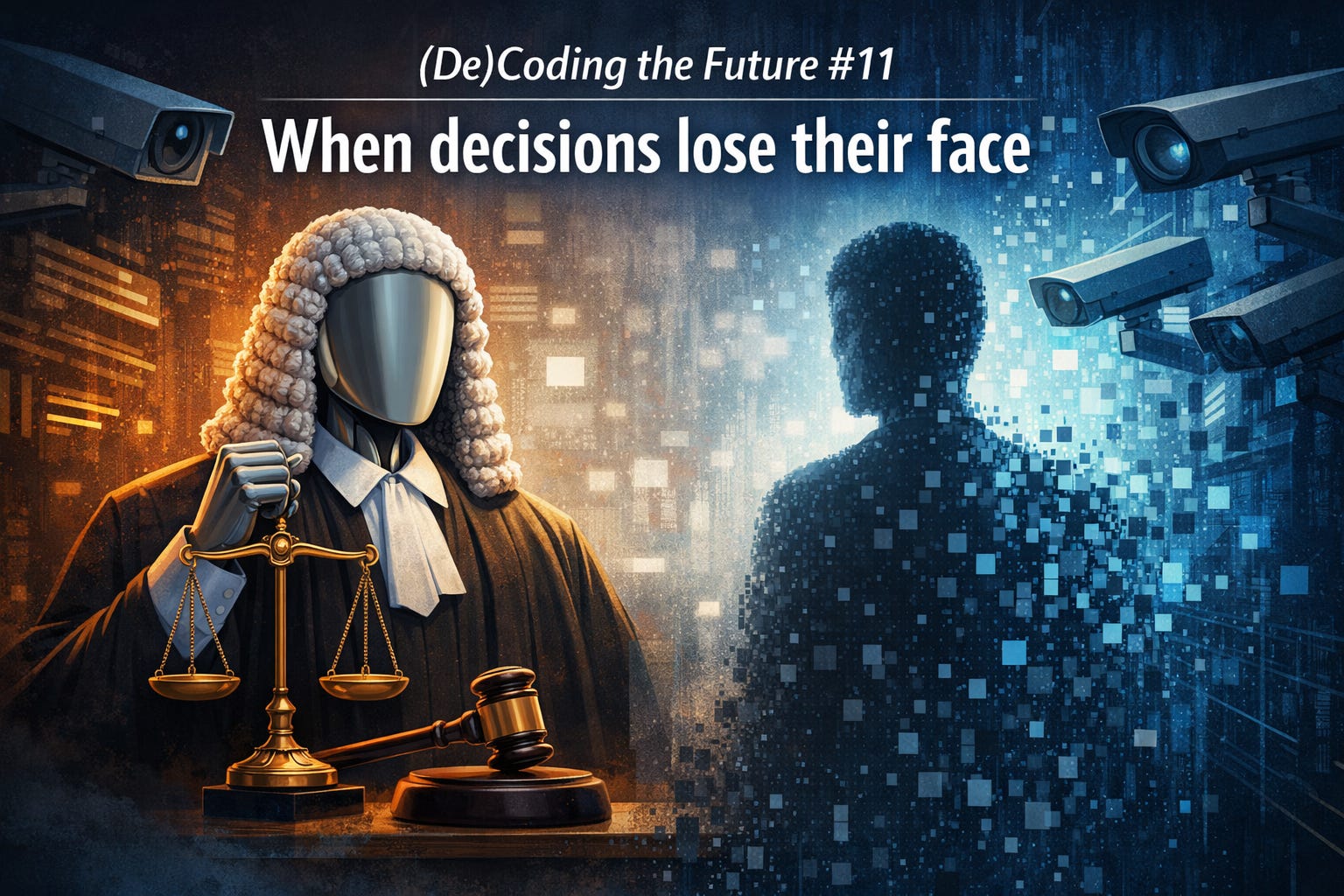
Over the next five years, the President of the Republic will assume an even greater importance. Not because the office will govern more, but because the real centre of decisions that affect people’s lives is moving away from the places where democracy has traditionally learned to recognise them.
For centuries, even in the most bureaucratic societies, relevant decisions were always made by people. They could be unjust or wrong, but they had an identifiable author. Today, it is becoming normal for decisions with real impact to emerge as automatic outputs: notifications, classifications, or refusals issued by systems that no one consults at the moment they decide.
The discussion (which is not taking place) about the digital euro ahead illustrates this shift well. Regardless of the final form it may take, it will make something new technically possible: monetary rules, restrictions, or incentives being applied automatically to each citizen, without a specific human act at the moment decisions affecting their digital wallet are made. This marks a rupture. The near future will not be a re-edition of the past, because the very place where decisions are taken is changing.
Until now, when we spoke of “scale,” we referred to identical decisions applied to many. What changes with automated AI systems is something else entirely: the ability to apply general rules differently to each person, in real time. Scale is no longer merely about how many are affected by decisions, but about how each citizen can be affected in a personalised way.
It is in this context that a silent fragility of our democratic apparatus becomes visible. The Constitution was designed for a world of human decisions—identifiable and contestable. When decisions are executed by automated intelligent systems, rights remain in the text but lose practical effectiveness: it is no longer clear who decides, whom to ask for explanations, or where to exercise the right of challenge.
In light of this, the answer is not a constitutional revision. The problem is not the lack of laws, but the displacement of power toward processes that operate outside the normal reach of democratic accountability. When power loses its face, legalism always arrives too late.
Even when the impact of technology was rarely mentioned in the public sphere, the framing remained generic, centred on adaptation and professional re-skilling. Without detracting from the merit of those who at least touched on the issue (I detected only the case of Cotrim de Figueiredo), this mainly reveals a collective difficulty in formulating the problem, when what is at stake is the transformation of the very mechanisms of decision-making, responsibility, and power.
This is where magistracy of influence becomes decisive: the institutional capacity to demonstrate, before public opinion, where and how decisions are made before they normalize without scrutiny. Intelligent decisions at the instrumental level can be obtuse at the democratic level and even from a human perspective. In the time ahead, ethical and civic discernment will matter more than political experience or the mere ability to mediate interests.
That role has already been exercised among us. In 2021, the President of the Republic vetoed a bill that would have allowed the use of facial recognition technologies in public spaces. This was not a rejection of the technology itself, but a judgment that the safeguards offered to citizens were insufficient. The veto did not solve the technical problem. Still, it prevented automated decisions with direct impact on concrete individuals from becoming the norm without public debate or clear assumption of responsibility.
These problems are not new, but AI makes them incomparably more intense. In the Netherlands, automated systems used to detect fraud in social benefits classified thousands of families as guilty without effective means of defence, repeating the error case by case until the damage became irreversible. Today, something similar happens with freedom of expression: automated systems decide who is removed, limited, or made invisible on digital platforms, in real time and in different ways for each person. What is new is not the error, but its speed, repetition, and depth. Once these decisions become part of the infrastructure, correcting them afterwards is no longer enough.
Democracies rarely collapse when someone decides too much.
They collapse when no one decides, and no one is accountable.
We are approaching that silent and fatal point for democracy.