

🇬🇧 English edition — Portuguese version here.
“The code no longer merely executes orders — it writes them.”
Dario Rodrigues (2025)
Intelligence becomes abundant. Value becomes programmable. And trust becomes automated.
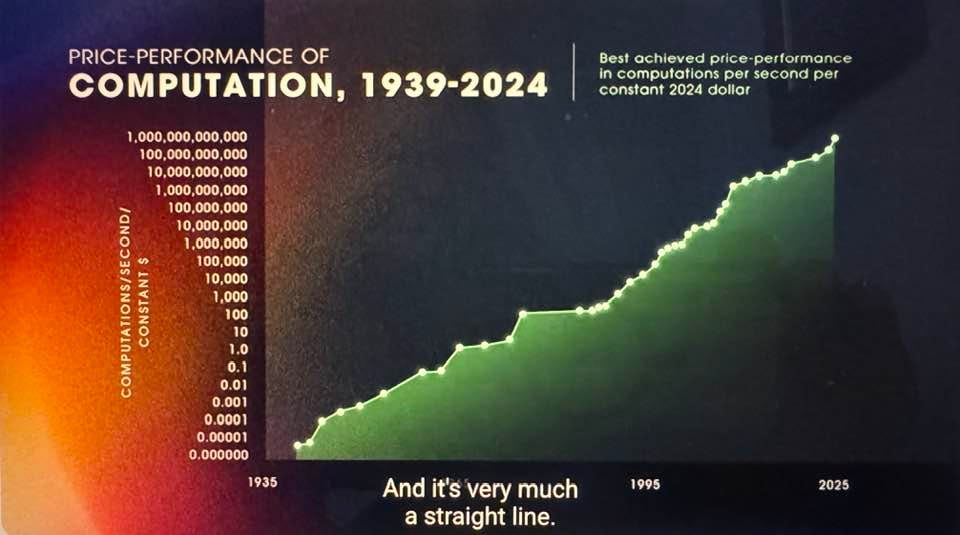
Source: Kurzweil, Ray. (2024). Price-Performance of Computation, 1939-2024. The Kurzweil Library – SIN Charts. Available at: https://www.thekurzweillibrary.com/sin-charts . Retrieved in 24th de October 2025.
1. The Price of Thinking
Since 1939, the cost of computing has fallen by more than a billionfold.
The chart is clear: on a logarithmic scale, it’s a line that keeps climbing—and it never stops.
With every new generation of chips, the cost of processing information drops, capacity grows, and demand expands.
It’s the old law of supply and demand: the more accessible computing becomes, the more we need it.
Hence, the global race for data centers—vast reservoirs of cognitive energy that feed artificial intelligence.
Yet there’s a decisive point that often goes unnoticed: the more AI becomes available, the cheaper it gets to produce each new unit of intelligence—and the cost of generating additional thought and labor approaches zero.
First, the cost of intellectual labor disappears—both repetitive and creative, technical and cognitive.
Then, robotization makes physical labor almost free—first the standardized, then nearly all of it.
As automation removes labor scarcity, its economic value plunges.
It is the price of abundance.
The brute force of computation remains indispensable to sustain the infrastructure of artificial intelligence—to train models, process data, and power global networks of decision.
Yet brute force alone is no longer enough to create value, meaning, or trust.
What now matters is the direction of this abundant calculation, the sense of distributed intelligent processing, and the purpose of shared knowledge.
2. From Energy to Value
When the capacity to think with machines becomes practically free, the effort associated with such work ceases to be scarce.
And in economics, anything that ceases to be scarce loses value.
Thus, what now serves to measure value is no longer the effort something embodies but the practical result it produces—its utility, impact, and benefit.
A text may take hours to write by a human or seconds to generate by an AI; its value will no longer depend on the time or labor invested but on the relevance of what it communicates.
This is where the new digital money comes in: stablecoins, tokens, and smart contracts.
These decentralized systems connect computational power to the verification of community benefits, converting energy and information into economic trust.
Cryptocurrencies thus cease to be mere means of payment and become instruments of validation, proving that something has happened, and are worth only insofar as that something brings real value to the communities that use them.
To understand this, one must grasp what smart contracts are.
They are the bridge between the AI that decides and the blockchain that guarantees.
These are self-executing programs that carry out agreements when real-world conditions are met, translating human trust into verifiable code.
It is this guarantee of automatic execution that enables distributed trust.
For example, cryptocurrencies can pay a farmer as soon as a sensor confirms a harvest delivery, compensate an environmental project when data confirms a reduction in carbon emissions, or settle an insurance claim the moment a vehicle is detected as immobilized after an accident.
They can also remunerate an artist whenever a digital work is viewed or played, release research funds once results are peer-validated, or issue verified learning certificates upon a student’s completion of an accredited online course.
In more sensitive ethical contexts, they can finance healthcare only when clinical indicators confirm improvement, distribute humanitarian aid exclusively to those in verified crisis zones, or grant micro-payments to students in vulnerable regions upon meeting learning milestones.
Even in global logistics, payments for shipping and storage can be released as soon as GPS confirms delivery and independent sensors (e.g., thermometers) validate cargo quality.
In simple terms, AI produces knowledge, and blockchain ensures trust.
Together, they form a new verification economy—a crypto-economy—where value is not born of effort or scarcity, but of proven benefit.
3. 💧 The Old Paradox of Value
Adam Smith called it the paradox of water and diamonds:
Water is essential to life, yet it is cheap.
Diamonds are useless, yet expensive.
During the twentieth and early twenty-first centuries, the digital economy repeated this dilemma.
Knowledge—abundant and vital—became worth less than the attention it attracted, and exchange value came to reside in data, clicks, and advertisements.
However, this monetization of attention carried a hidden cost: it turned polarization into a business model.
To sharpen market segments meant more clicks per ad, but by rewarding outrage, shock, and division, digital platforms fractured the public sphere and eroded the very foundation of democratic trust.
Fortunately, the paradigm may now be shifting.
With AI, decentralized digital money, and smart contracts, it becomes possible to measure and reward real use-value—the benefit something generates, the positive impact it produces, and the meaning it adds.
Utility ceases to be invisible: value is no longer a promise but a measurable effect, verified by the impact it produces within the communities through which it circulates—like a carbon credit that is worth something only if the forest truly exists, or an energy token that retains value only if it genuinely brings light to people’s lives.
“The digital diamond of the future will not be the rare datum but the brilliance of its benefit.”
4. The Ethical Consequence
As the cost of thinking approaches zero, morality becomes the new scarcity.
The exchange value of goods and services is no longer defined merely by price but by a meaning recognized as ethical, measured through verified usefulness within the communities that trade them.
The rise of an economy of verifiable benefits—where value is born from the good that is proven rather than the exhausted effort—signals a shift in which work gives way to purpose, and calculation is shaped by collective conscience.
The proliferation of data centers will only make sense if the energy they consume returns to the world as knowledge, utility, and well-being.
For the challenge is no longer to calculate more but to understand better—to give the energy that powers artificial intelligence a truly human purpose.
🪶 Less energy per idea. More meaning per watt.
Dario Rodrigues