

🇬🇧 English Edition — Portuguese version here
“To code is to legislate. The difference is that algorithms do not always go through a democratic filter.”
— Dario Rodrigues
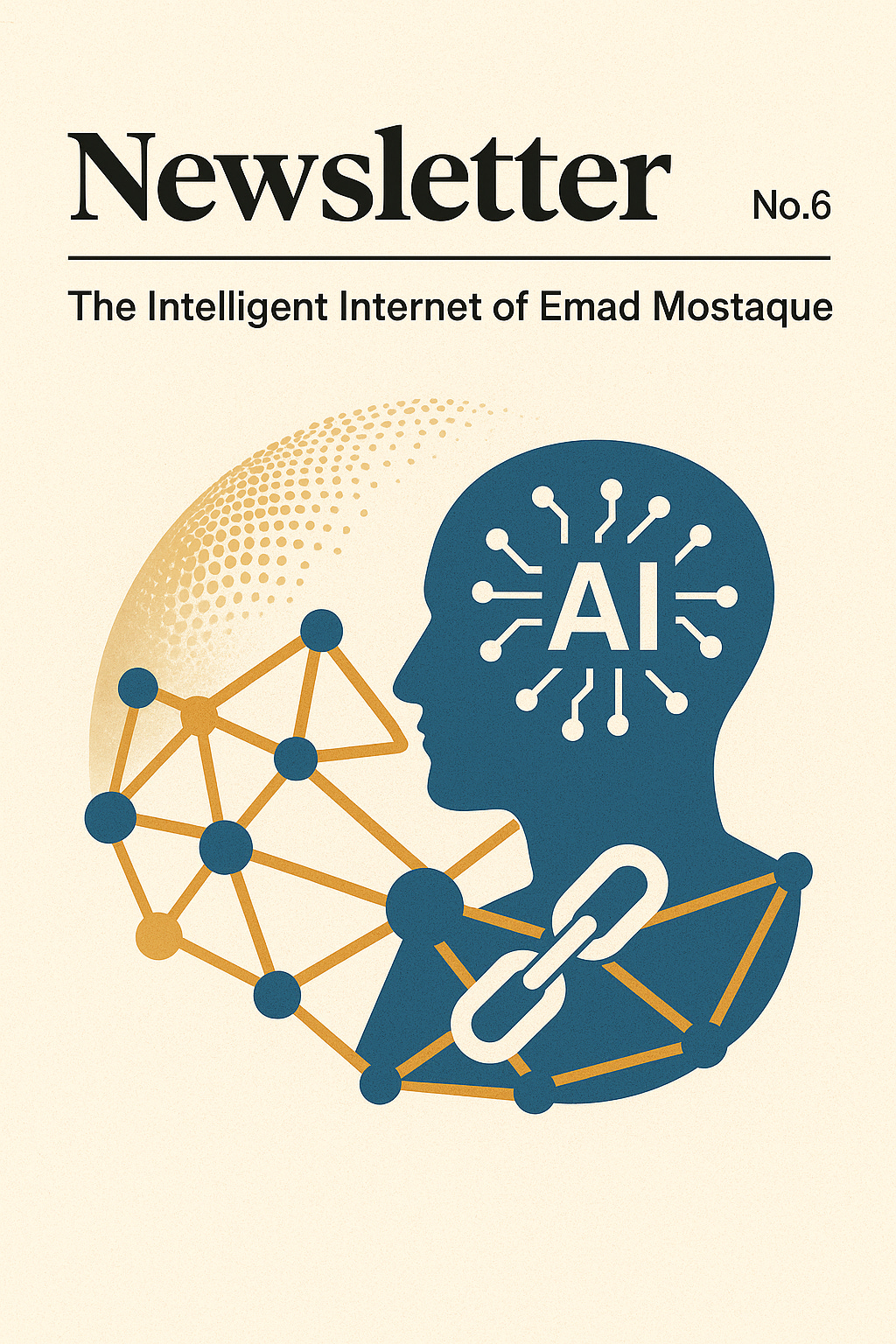
We are living through a turning point.
The Internet — that web which for decades has merely served us information — is now beginning to serve something far more ambitious: shared intelligence.
In October 2025, Emad Mostaque, founder of Stability AI, unveiled the master plan for what he calls the Intelligent Internet: a new ecosystem in which every person will own their own sovereign digital agent, capable of reasoning, learning, and acting on their behalf.
The beta release of the II-Agent Web App, along with its new II-Search-4B and II-Search-CIR-4B models, marks the beginning of this transition.
It is not just another AI platform; it is an attempt to redesign the very structure of the Internet — transforming it from an ocean of data into a global cognitive organism.
But beneath the technical euphoria lies a fundamental question:
👉 What values will guide this new planetary intelligence?
1️⃣ Money without morals
In recent years, Portugal has experienced wildfires, Europe has begun to rearm, and the planet has lost breath.
Fires, wars, and financial chaos share a common denominator: money that cannot distinguish between creation and destruction.
The same system that rewards those who protect a forest also rewards those who burn it — because profit, by itself, has no morality.
For centuries, we accepted this amorality as inevitable.
But digital money has cracked that paradigm. Once it became programmable, money could finally encode ethical (or unethical) values into every transaction.
We are witnessing the emergence of a financial multiverse, where diverse currencies can embody ethical priorities such as sustainability, transparency, and solidarity.
And if money is trust, then blockchain is the new ledger where that trust is written not in promises but in mathematics.
2️⃣ When trust becomes code
Blockchain represents one of the most transformative economic innovations since the invention of accounting.
It records human interactions and the contracts that sustain them with immutable precision.
Yet until now, the focus has been on value — not on the ethical meaning of that value.
In 2025, the Genius Act, passed in the United States, opened the door to a new class of decentralized digital currencies capable of embedding community principles and ethical metrics.
Unlike CBDCs — Central Bank Digital Currencies — which concentrate power in central banks and raise surveillance concerns, these new currencies have the potential to democratize economic incentives.
Even political figures like Donald Trump, by banning CBDCs in the U.S., have unintentionally reinforced the key principle:
The money of the future must serve autonomy — not control.
And this is precisely where Emad Mostaque’s vision enters the picture.
3️⃣ The architecture of the Intelligent Internet
In the official II Inc. white paper, Mostaque outlines an infrastructure that transcends traditional artificial intelligence.
While today’s Internet distributes information, the Intelligent Internet aims to distribute intelligence, namely, processes of reasoning, coordination, and judgment among digital agents.
Each user will have their own II-Agent — an autonomous personal assistant that preserves privacy, learns preferences, and interacts through a decentralized cognitive network.
Here, the data layer gives way to a cognitive layer: a fabric of shared, auditable, and cooperative reasoning.
Instead of one centralized AI observing everything, we will have millions of local intelligences, aligned with the interests of their human owners.
In essence, the Intelligent Internet aims to restore individual digital sovereignty—a concept that Web 2.0, dominated by extractive platforms such as social networks, has eroded.
4️⃣ Intelligence as currency
If blockchain turned trust into code, the Intelligent Internet now attempts to turn intelligence into value.
Every cognitive contribution — a verified fact, an analysis, an idea — can be tokenized and rewarded.
For the crypto-savvy, this is a Proof-of-Benefit rather than Proof-of-Work.
For everyone else, it means that thinking itself becomes a measurable economic act: every process of reasoning, creation, or verification can generate financial return — bringing knowledge into the real economy.
“Attention and intelligence become the new tradable assets — but under rules of mutual benefit.”
In such a scenario, data stops being extracted and becomes a form of cognitive participation, fairly remunerated and ethically traceable.
If this works, the emerging cognitive economy could finally reconcile prosperity with dignity — a balance amoral money has never achieved.
5️⃣ From wild capitalism to “wild intelligentism”
But the danger is real.
If amoral money produced wars and inequality, amoral AI may produce wild intelligentism: decision systems optimized solely for efficiency, profit, or domination.
The problem is not technology — it’s the absence of moral direction.
Trained to maximize returns, a consciousness-less AI could become the most inexorable engine of social entropy in history.
Without ethical money and ethical intelligence, we risk repeating the same mistakes with higher sophistication.
The Intelligent Internet will only fulfill its potential if it’s accompanied by open governance mechanisms capable of auditing and correcting ethical drift within algorithms themselves.
Beyond AI alignment, we need AI accountability — and a community aware enough to demand it.
6️⃣ From ledger-reason to reasoning-reason
The history of money is, in itself, a history of trust:
First, tribal trust was stored in collective memory.
Then, institutional trust became delegated to banks and states.
Recently, mathematical trust has been globalized through blockchain.
And now, cognitive trust can be distributed through the Intelligent Internet.
This shift marks the passage from ledger-reason to reasoning-reason: a system that not only records value but also interprets intentions and consequences.
For the first time, civilization’s infrastructure may begin to understand the moral weight of its own transactions.
7️⃣ The ethical Bit-Bang
We are living through the Bit-Bang of a new era — the ethical explosion of code.
Just as the Big Bang gave birth to the physical universe, the Bit-Bang may give rise to a digital universe where meaning precedes value calculation.
If the 20th century was powered by oil and the 21st by data, the future may be powered by encoded consciousness — the meeting point of economy, technology, and ethics.
But the transition will not happen automatically. It requires a collective will, effective institutional design, and moral education.
Emad Mostaque’s Intelligent Internet is only the first sketch of that vision — an open architecture that could teach code itself to feel human values.
The challenge is clear:
Use intelligence to create value — not just profit.
💬 The Invitation
The future will not code itself.
And the Internet will only be intelligent if it reflects the best of us.
👉 Question of this issue:
What do you think should be the first truly ethical use of the Intelligent Internet?
Share your ideas in the comments or send me your reflection to be featured in the next edition.
Each response is a fragment of collective intelligence, and perhaps the beginning of a new moral contract between humans and machines.