

For more than a decade, I have investigated the tension between economic systems grounded only in price and the new digital frameworks of distributed trust. From Cyberethics-Mix (2011) through the Blockchanging trilogy (2021), where I already argued that smart contracts allowed the reintroduction of ethical aspects in money, through my work on decentralized governance (2024) and on the impact of blockchain and artificial intelligence (AI) on business and sustainability (2025), to my current research on the alignment of artificial intelligence agents with human values (2026), it is from this trajectory that the main thesis of this article emerges.
I present it as a civic warning. Over the next 500 days, in Brussels, Washington, Beijing, and dozens of other capitals advancing their own digital currency pilots, the global digital monetary architecture of the coming decades will largely be decided. Structural decisions of this nature, when made far from public debate and treated as a purely technical matter, tend to harden into forms that later prove irreversible. And it is precisely because I know this, and because I consider that what is at stake is the shape of the money our children will use, and, even more, the shape of the State they will inherit, that I take the floor here.
We are crossing a civilizational transition comparable to the invention of coined money, the printing press, or electricity: one of those in which structural choices are consummated before most people realize there were choices to be made, and in which the point of no return arrives not by imposition but by adoption, because the infrastructure has been installed, because the habit has formed, because the question has lost any political interlocutor available to it. It is before that silent normalization that I step in here, trying to place this debate in the public sphere, in Portugal, in Europe, and in the world, while the civic window is still open, seeking that, on a matter of such consequence, democratic scrutiny arrives in time in any geography.
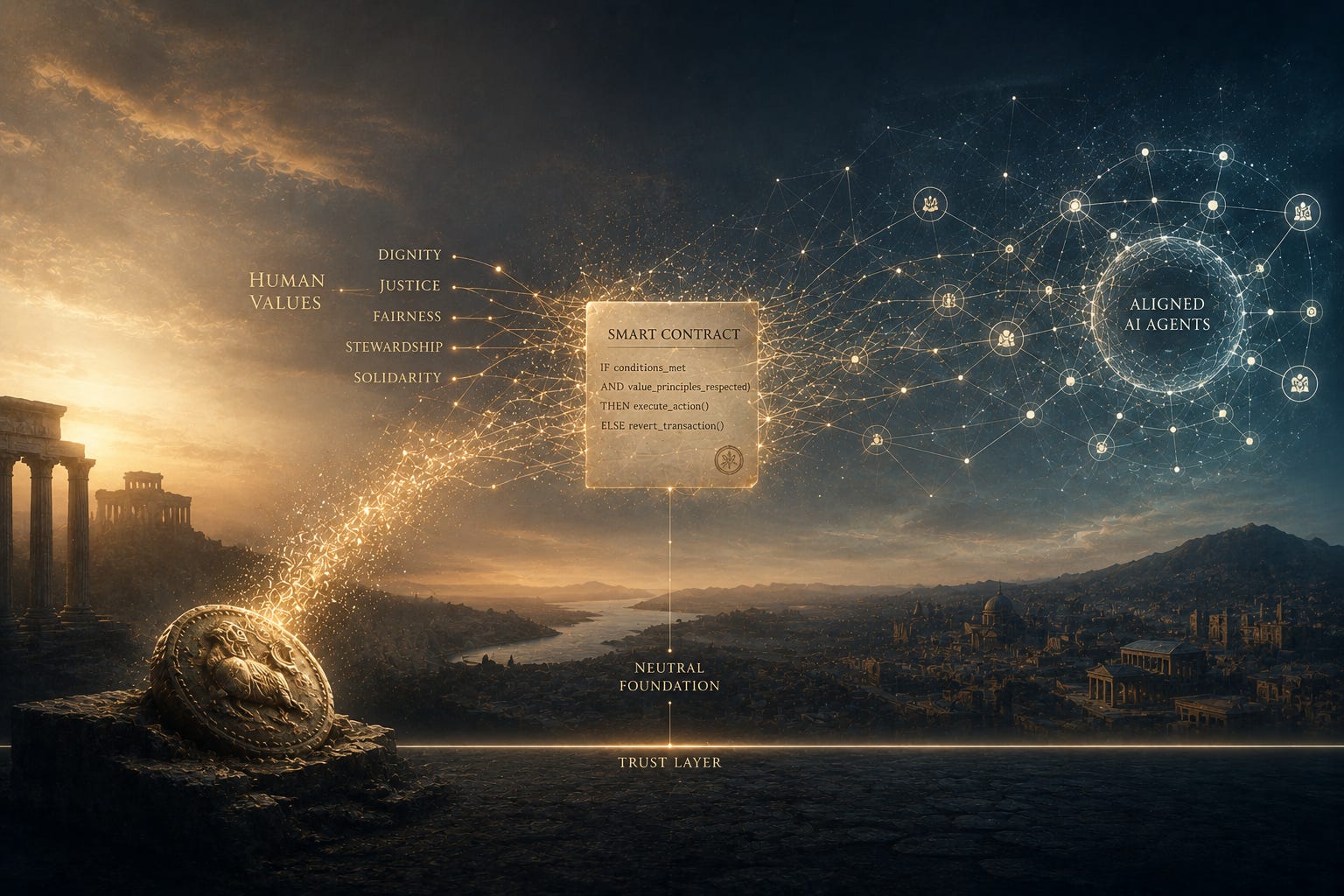
The underlying thesis is simple and stable: the alignment of artificial intelligence (AI) with human values is not resolved solely within the respective models; it is also, and perhaps above all, resolved in the architecture of the economic instrument with which the agents these models now produce will transact. Money, by construction, a scalar indifferent to anything other than price, is today the interface between AI and the world. If that interface remains one-dimensional, no internal alignment technique will compensate for what the economic infrastructure does not allow to be expressed. If money becomes multidimensional, as human values are, with ethical dimensions encoded in smart contracts (automated or self-executing agreements) running on a neutral base layer, agents will operate in a world whose main economic-incentive infrastructure will no longer reward amorality through ethically neutral transactions. It is a practical path in the short term, without waiting for a complete reconstruction of the monetary system. Reform, not refoundation. I share it to add to a broader understanding of what is truly at stake in this age of AI.
The starting point: money has only one dimension
The problem of AI alignment with human-centered values is usually framed as an internal problem for the models: how to train them, control them, and prevent them from producing dangerous outputs, including existential ones. It is an important discussion, but an insufficient one, because the agents these models produce do not operate inside the machine. They operate in the world, and the world has an economic infrastructure older than any alignment technique, whose moral blindness is the blind spot of the current debate.
Imagine two bank transfers of the same amount, made in the same second, in opposite parts of the world. One is an anonymous donation to a school in a war zone. The other is the payment for a shipment of weapons that will destroy that very school. For the financial system, these are technically identical operations, processed at the same speed and recorded with the same neutrality. Money moves with equal ease in both directions, and that symmetry is the purest form of amorality that economic history has produced.
After all, money, in itself, is a number. It is what is called a scalar: a one-dimensional measure, indifferent to what lies behind it. A thousand euros donated to cancer research is worth exactly the same in the wallet of whoever receives it as a thousand euros extorted. Money does not distinguish. It is amoral by construction, not by malice.
Coin money was minted around 2,600 years ago in the kingdom of Lydia to allow exchange between strangers in communities too large for oral memory to serve as a collective ledger (that mental record was the primordial money). This civilizational gain came at a silent cost: the qualitative dimensions that group memory preserved (who owes what to whom, in exchange for what, with what urgency, with what reputation) no longer fit inside the instrument of exchange itself. For a long time, this amorality of scalar money, which measures only quantity, not quality, was partially mitigated by the fact that money was always handled by humans.
People sleep, hesitate, and have a conscience. That human friction has functioned as an implicit filter. It did not solve the problem of money’s moral blindness, but tempered it for the last twenty-six centuries. With ever greater difficulty, however, as the disconcerting state of the world demonstrates.
The new threat: the disappearance of human mediation
And now we arrive at an inexorable inflection point: AI agents, autonomous programs capable of carrying out transactions without immediate human supervision, do not sleep, do not hesitate, and have no conscience. They compress the time between decision and execution to near zero. Human contingency, which, for two and a half millennia, has served as a partial mitigator of money’s amorality, is being removed from the system.
Dirk Helbing, professor of Computational Social Science at the Swiss Federal Institute of Technology in Zurich (ETH Zürich), developed and systematized the conceptual basis of this critique in 2014, in a paper titled “Qualified Money: A Better Financial System for the Future”. There he writes, with disarming clarity, that money today is effectively reduced to a single control variable (the simplest mathematical quantity one can conceive), being neither multidimensional nor endowed with memory. And he asks: why should a healthy financial system function with a single type of money, when no ecosystem, no organism, no control system works that way? Helbing wrote before the emergence of artificial intelligence agents, and his concern was the recurring systemic instability of the monetary system. The extension of this argument to the problem of AI agents is my own original contribution: what Helbing identified as a structural defect, already visible in 2014, becomes an acute vulnerability when human contingency (that friction which still served as a partial mitigator) is removed by the speed of autonomous agents.
Charles Stross, a British science fiction writer with training in pharmacy and computer science, anticipated this line of thought in narrative form. In the novel Accelerando (2005), he describes the emergence of what he calls “Economics 2.0”: a regime in which automated corporate entities, heirs of the first companies based on artificial intelligence, transact with each other at speeds inaccessible to human scrutiny, as well as, at the limit, expel humans themselves from the economic circuit. Fiction made, two decades ago, the diagnosis that financial regulation is only now beginning to sketch. The value of literary speculation is precisely this: to make imaginable a structural configuration that looked distant, but which approaches with every cycle of advancement of autonomous AI agents.
Ben Goertzel, one of the pioneers of so-called Artificial General Intelligence (AGI), has argued, in books, lectures, and in his essay “A Beneficial AGI Manifesto”, that the security and civilizational benefit of advanced AI systems are not guaranteed by mechanisms internal to those systems, but by the economic and organizational architecture in which they are developed and operate. For Goertzel, there is no way to strictly guarantee that AGIs will be beneficial (and it is time for people to understand that they are coming) if technical value alignment is imposed by restricted groups; the structural safeguard lies instead in the decentralization of the hosting and training infrastructure, of governance, and of economic incentives. These conditions must be present from the beginning, not added later.
In other words, we have non-human economic intelligence operating inside financial systems designed for human contingency. This disproportion is the blind spot of current regulation.
The old way: creating new currencies with ethics built into them
I considered, for years, that an ethical solution to money would have to involve creating alternative currencies that intrinsically incorporated the values of the community and using them. There are working examples: Giveth, in the philanthropy ecosystem, is a cryptocurrency whose use is tied to the social impact of the funded project. The currency measures ecosystem value, not just price. But there is a practical problem: these community currencies have limited liquidity; when someone wants to convert them into euros or dollars to pay rent or the supermarket bill, the multidimensionality is lost immediately. The interface with the dominant scalar system undoes, in one second, everything that made the community currency special.
For this reason, this path seemed elegant to me, but adoption was slower than the problem's immediacy warranted. Observing such slowness, I lamented this impracticality in successive interventions, flailing like a drowning man in search of a rescue fast enough to keep pace with the dizzying pace of AI.
The interface with the dominant scalar monetary system is the friction point: since most transactions still require conversion into scalar currencies such as euros, dollars, and bitcoins, the multidimensionality of cryptocurrencies and community tokens erodes with each conversion. It is true that there are ways to reduce this friction via fostering the circularity of utility tokens within the community ecosystems that use them, so that they enter and exit less often and depend less on the amoral system of conventional money. Moreover, in a horizon of greater material abundance, made possible by artificial intelligence itself, it is conceivable that the gravitational pull of scalar money may decrease enough for new multidimensional community economies to coexist peacefully with universal networks based on stable anchor currencies. However, for the short window of the next 500 days, in which several authors believe the global digital monetary architecture of the coming decades will be decided, this path alone is not enough. It needs to be complemented by another, faster one. The ultimate variable, let us recall, is not monetary; it is the sustainability of the very civilizational project that amoral scalar money is jeopardizing.
The discovery: separating the “exchange value” layer from the “use value” layer
I ask for the reader’s special attention here because the technical point is simple, but the consequences are enormous.
The right question to ask in time is not “how do we invent a new money with ethics built into it?” The right question is “how do we keep money stable and neutral, and add to it an ethical layer?”
The answer involves two existing pieces that are silently gaining traction.
The first is the “stablecoin”, a cryptocurrency designed to always be worth the same as a traditional currency, usually the dollar. It does not fluctuate. It functions as a digital version of the dollar, transferable in seconds to anywhere in the world without going through the banking system. The volume of stablecoin transactions has grown, and most people using them do not even know it, as they mostly circulate in the background of financial applications.
The second is the “smart contract”, also known as a self-executing contract. It is a small computer program that runs itself automatically when certain pre-defined conditions are met. For example: “release the payment to the supplier only when the cargo sensors confirm it has arrived in good condition”; or “transfer the donation to the NGO only when an independent auditor certifies that the carbon emission targets have been met”. The smart contract is public, verifiable by anyone with technical competence, and executes itself without an intermediary.
The key piece is this: the stablecoin does not bring multidimensionality. It is flat, it is scalar, it is a digital dollar. It measures only the quantity dimension. But the smart contract around it introduces the missing dimensions, making it vectorial. Sustainability, ethical conditionality, performance, deadlines, and quality. All of this can be embedded in the contract, and the stablecoin becomes simply the neutral substrate on which that plural logic runs. Conditional currencies and targeted vouchers have existed before, but never natively, globally, and without intermediaries, integrated into a single technical layer. That is the novelty.
It is worth naming what makes this architecture technically possible now, and not twenty years ago. The two layers integrate only because they rest on a common underlying infrastructure: distributed ledger technology (generically referred to as blockchain). This infrastructure brings a kind of trust that did not exist before: a “distributed trust” that does not depend on a central authority to validate transactions or interpret rules, but instead emerges from the simultaneous verifiability by thousands of independent nodes in a network. It is this new technical pillar that allows the stablecoin to be neutral without a centralized intermediary and the smart contract to be self-executing without a human arbiter. If this new kind of trust is not sufficiently decentralized, the two-layer architecture degenerates into a centralized architecture, more or less disguised, with different intermediaries at each layer that ultimately unify control. Because of this danger to democracy, blockchain is not a technical detail; it is the political condition of the pluralist monetary architecture I defend here.
It is a two-layer architecture. At the bottom, the stability of scalar money. On top of that, it’s new programmable ethics.
Why does this solve the problem of AI agents?
When an AI agent executes a transaction within a smart contract that requires verification of social or environmental criteria, the conditionality is embedded in the protocol. It does not depend on the agent’s conscience. We have not yet built automated infrastructure for problems that are themselves automated and unfold at machine speed, but we are beginning to build it now.
The smart contract replaces human contingency with programmed conditionality. It is not the same thing, and there are important nuances, but, pragmatically, it serves an analogous function: it restores structural friction to the system. That friction persists despite the speed of AI agents because they operate automatically, without anyone needing to activate them in time.
It is worth inverting a common intuition here. One might think that a stablecoin, being still standard scalar money in new clothing, is ethically neutral: it neither improves nor worsens the system. This is not so. A stablecoin without an ethically relevant smart contract is, in fact, worse than traditional money. Because it inherits all the structural amorality of scalar money and eliminates the only mitigator: human contingency. It moves at digital speed, crosses borders without friction, and executes without hesitation. It has the moral blindness of today’s money, now coupled with the speed of automated agents. It is the worst possible combination, and it is precisely the configuration expanding in the market today, with volumes already rivaling those of traditional transaction systems.
For this reason, the stablecoin alone is not a solution. It is an acceleration of the problem. It only becomes part of the solution when it serves as the neutral substrate for a layer of smart contracts that programmatically reintroduce the dimensions that scalar money suppresses. Without that second layer, the first layer is more dangerous than what it seeks to replace.
This is, in my view, one of the structurally most consequential political discoveries since the invention of money, and almost no one is talking about it in terms that the common citizen, journalists, and policymakers can understand and evaluate.
Three pitfalls that no one mentions
It would be frivolous to present all of this as a panacea. There are three blind spots that should be identified honestly.
First, not all stablecoins are born equal. There are stablecoins issued by centralized private companies, such as USDC from Circle and USDT from Tether. Their stability depends on those companies actually having the reserves they claim to have and on the US government not deciding, at some point, to freeze them. There are also decentralized stablecoins, with issuance rules verifiable by anyone and without a single entity controlling them. The difference is structural. Brian Armstrong, of Coinbase, defends the model of regulated private stablecoins. Others, such as Changpeng Zhao, former CEO of Binance, emphasize that the decentralization of infrastructure is precisely what protects citizens from sovereign arbitrariness. Private initiative was never about instruments without rules; it was about clear rules, known to all and equal for all. “Smart contracts” are exactly that: codified, transparent rules executed without discretion. This is institutionalized private initiative, not its negation. But this only applies if the underlying infrastructure is itself neutral. A centralized stablecoin, in which the issuer can, at its own discretion, annul a user’s entire position in its currency, does not meet the criterion: smart contracts can run on top of it, but the value on which they operate is revocable, and the programmability that the citizen believes to be theirs is held hostage to the tolerance of whoever issues the base layer. And hostage programmability is not programmability. And, as will be seen below, the same criterion applies, with much greater severity, to centralized sovereign digital currencies (CBDCs), which we will address shortly: the decisive test is not who issues the currency, but whether programmability lies on the citizen’s side in an effective and protected manner, which presupposes that the corresponding base layer is itself neutral.
Second, the smart contract needs to know whether real conditions have been met. For this, it relies on special sensors, known as oracles, which are external information sources (off-chain) that the contract consults to make automated decisions within the blockchain network (on-chain). Who certifies that the supply chain is sustainable? Who measures carbon emissions? If the oracles are controlled by a single entity, multidimensionality collapses into “whoever controls the oracle controls the contract”. The oracle problem is the current frontier of distributed trust engineering, and no serious political proposal can ignore it.
Third, a stablecoin used without a smart contract is, literally, a digital dollar. Most stablecoin transactions today involve only trivial programmability. They are merely accelerated transfers. The deficit of multidimensionality is resolved only when a programmed contract runs on top of the currency. The base layer, on its own, resolves nothing.
The political choice that is coming
In Brussels, preparations for the digital euro are underway. In Beijing, the digital yuan is already circulating in an advanced pilot phase. In Washington, on January 23, 2025, the American administration signed the executive order “Strengthening American Leadership in Digital Financial Technology”, which federally prohibits the issuance of a central bank digital currency and steers the digital monetary policy of the United States toward the development of private dollar-backed stablecoins. But the discussion does not end there. From Brasília to Mumbai, from Nassau to Abuja, more than 100 central banks are today studying digital versions of their currencies, with widely varying degrees of maturity. And in parallel, in economies with chronic inflation, such as Argentina, Turkey, or Venezuela, dollarized stablecoins already function as the de facto dollar, outside any dedicated institutional architecture and beyond the reach of the three major regulatory capitals. These paths are not variations of the same design. They are distinct architectures, with radically different political consequences, and the confusion between them is the greatest obstacle to serious public debate in any geography.
It is necessary to begin by dispelling a confusion of vocabulary. When one speaks of Central Bank Digital Currency, or CBDC, one refers to a monetary unit issued directly by the sovereign monetary authority (the European Central Bank, the Federal Reserve, or the People’s Bank of China) in native digital form. It is distinct from private stablecoins, which are issued by companies (such as Circle, Tether, and Paxos) and are backed by reserves. Both are digital currencies, but they are not the same thing. The choice between the two, and within each the choice between more or less open variants, is the real political question of the next 500 days.
The first model is the one I defend here: open CBDC. The State issues a digital unit of stable value, neutral at its base layer, and each citizen freely applies whatever conditions they deem fit through smart contracts of their own choosing. The State guarantees legitimacy and stability; the citizen retains sovereignty over programmability. It is the digital equivalent of today’s physical euro, with enhanced functionality and no loss of liberty.
It is important, however, to stress that this open CBDC does not aim to occupy the entire monetary ecosystem. It should coexist, in healthy plurality, alongside decentralized private cryptocurrencies and with stablecoins that meet the same structural criterion already stated. Decades before cryptocurrencies, the Nobel laureate in Economics, Friedrich Hayek, already defended competition among private currencies as a way to limit the State’s monopolistic power over money. The architecture I propose here does not replace that competition; it gives it an additional stable anchor: those who prefer sovereign anchoring use open CBDC; those who prefer full autonomy from the State use native cryptocurrency with conditional traceability, opaque under normal conditions, auditable through judicial process; those who prefer stability with verifiable issuance rules use a decentralized stablecoin, provided that the second layer of smart contracts running on top of it is itself verifiable and compatible with the legal order. The three options coexist because they serve different legitimate user preferences. All of them are compatible with the thesis of this article, precisely because none makes criminal investigation structurally impossible nor allows the programmability of the second layer to operate beyond the reach of the law.
The second model is the conditioned CBDC. The State issues the digital unit but reserves the ability to program it for public policy purposes: incentives with an expiration date, restrictions by type of good, and behavioral incentives linked to climate or health targets. This is the temptation of Western central banks, and has been studied with technical seriousness in various documents from the European Central Bank and the Bank of England. Until January 2025, the US Federal Reserve was also investigating CBDC models before the executive prohibition mentioned earlier ended that line of work. The conditioned CBDC is not totalitarian, but it establishes an infrastructure whose real threat lies in its multipurpose nature: the same system that today subsidizes healthy products may, tomorrow, penalize travel, religious choices, or political positions. Whoever installs a conditioned CBDC pays in advance the engineering cost of any eventual transition to the next model, the planned CBDC. With it, such migration becomes a political decision made technically far more feasible.
The third model is the planned CBDC. The State issues the digital unit and integrates it into a broader system of behavioral governance, in which the use of money is coupled with a political, religious, geographic, or health identity. The digital yuan, in active development in China since 2014 and with urban pilots running since 2019/2020, moves in that direction. It is already operationally integrated with the private platforms WeChat Pay and Alipay, has programmable functions for conditional transfers and targeted subsidies, and, according to studies by the Lawfare Institute and the Australian Center for Independent Studies, its technical architecture is compatible with coupling to the social credit system. On January 1, 2026, an Action Plan from the Chinese central bank came into force, defining the next generation of the digital yuan’s operating system. The infrastructure is being built at a pace that far precedes popular demand: the Chinese State prepares the capacity before it is politically demanded. Here, money ceases to be an instrument of exchange and becomes an instrument of government. It is the complete reversal of the emancipatory civilizational function that coined money, inaugurated 2,600 years ago: to allow strangers to transact with each other without depending on any authority that knows them, remembers them, or judges them.
The position that democracy and liberty impose on the digital euro is clear: defend open CBDC (1), reject conditioned CBDC (2) on structural precaution, and condemn planned CBDC (3) on grounds of civilizational incompatibility with democratic liberty. And the underlying reason is the same in all three cases: the decisive test is on which side of the architecture of money lies the programmability of what is our main system of economic incentives. If it lies on the citizen’s side, atop a neutral base layer, there is institutionalized private initiative. If programmability lies solely with the currency issuer (no one will hold truly private cryptographic keys), there will be discretionary control over the core economic incentive system, with varying degrees of repressive sophistication.
This distinction must enter the public debate in Portugal, Europe, and the world in the coming months, before the digital euro and its global counterparts move from design to everyday infrastructure. This is not a matter for experts. It is the shape of the money our children will use, and of the State they will inherit.
What is missing: educating those who transact
If there is one point on which I am prudent, it is on adoption. Most people, and most companies, today have no notion of what a smart contract is, what an oracle is, or what changes when a standard transfer is replaced by a programmed transaction. Institutional trust, which for centuries was placed in central banks, notaries, land registries, and commercial courts, will have to learn to be placed also in open protocols, in which transparency is not an institutional promise, but rather a technical property: the code is public, the rules are visible, and anyone can, at any moment, verify its execution.
It does not happen overnight. And it does not happen without public education, without accessible tools and narratives, without close examples. The tax system presupposes locatable operators, a premise that is weakened as programmed transactions traverse diffuse jurisdictions and as digital agents increasingly become the protagonists. There is enormous regulatory work to be done, and even greater pedagogical work. Whoever works on the pedagogy first will win the debate.
The good news is that the way is open. Today, it is clear that there is no need to invent perfect community currencies in order to reintroduce ethics into economic exchanges. What is needed is a neutral, stable layer, carefully designed smart contracts, and citizens who understand the architecture being built around them.
The reform of money has already begun. It is happening in silence, outside the television news, in transactions that more and more entities execute without knowing they are participating in a civilizational change. What remains to be decided is whether we want that change to be free and plural, or captured and centralized. And that, yes, is a political decision, not a technical one.