

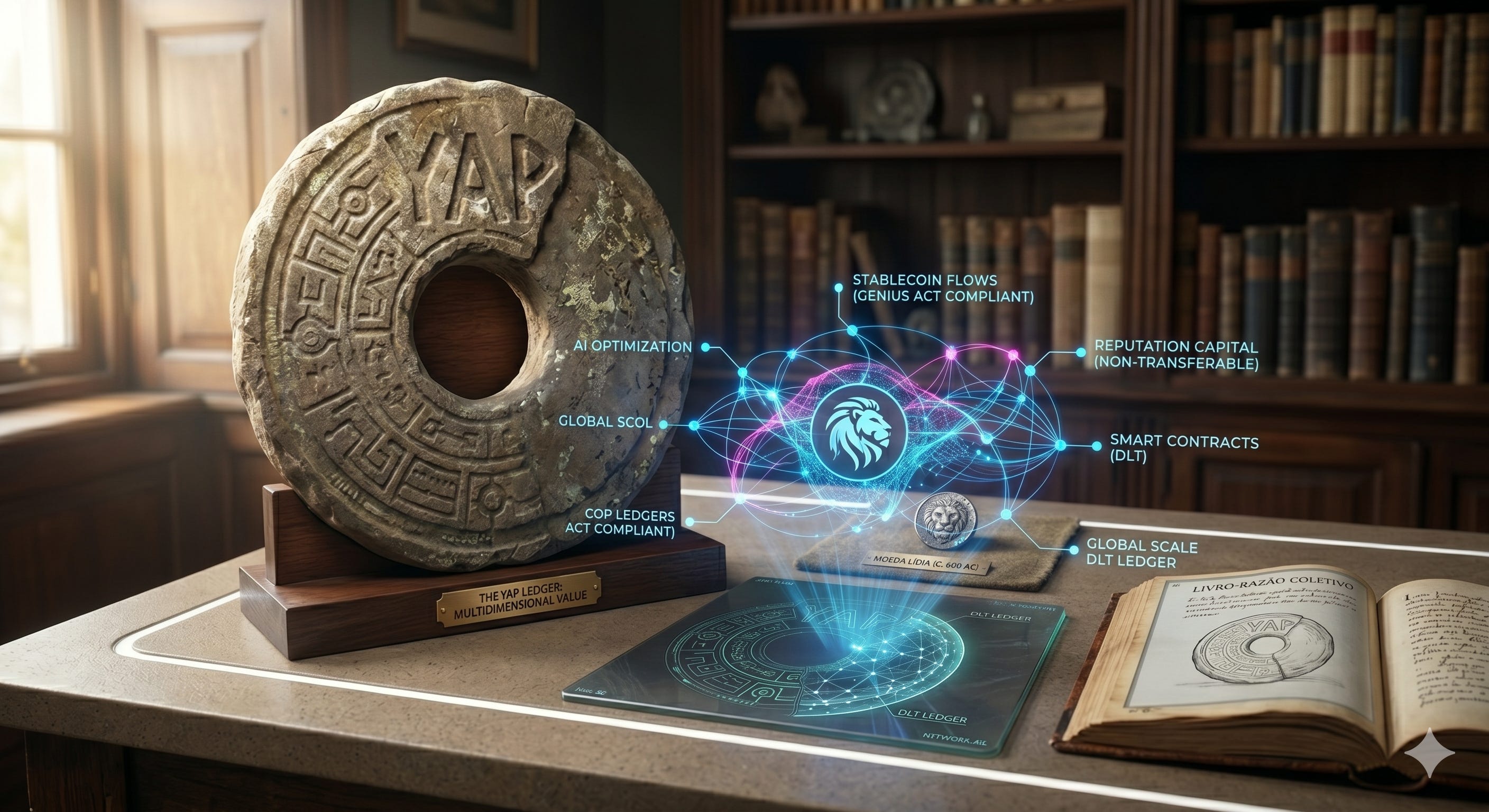
1. Why I Return to This Topic
A few days ago, I went on the NOW channel to comment on the court case between Elon Musk and OpenAI. Seven or eight minutes are not enough for a subject of this density, so afterward I made a longer video, around twenty-five minutes, in which I expanded on the central thesis. This text is the next layer. It covers what the video left implicit, responds to the most predictable objection (the one claiming that, even if new forms of money are built, a single exchange is enough for everything to collapse back into the same system), and introduces two elements the video did not address: the role of stablecoins and the regulatory regime emerging in the United States.
The thesis I defend here is not about who betrayed whom. It is not about Sam Altman as a person, nor about Musk as a whistleblower. It concerns the design of the economic incentives to which these organizations are subject, and the question that design makes unavoidable: can a non-profit mission survive inside an architecture that measures success on scales it cannot itself capture?
My answer is no. The OpenAI case proves this in exemplary fashion, through a structural inevitability.
2. The Institutional Question
OpenAI was founded in 2015 as a foundation. Its declared purpose was to develop artificial intelligence aligned with human interests, for the benefit of humanity, without the financial constraints associated with investor return expectations. Elon Musk was a co-founder and contributed several tens of millions of dollars at the time of the foundation.
Years later, the foundation became a Public Benefit Corporation, an American legal structure that combines profit with a social mission. Microsoft made a massive investment. Today, the entity is worth around 850 billion dollars. Almost one trillion. Orders of magnitude are completely different from those under which the foundation was originally created.
Musk accuses Altman of betraying the original mission. Altman defends himself by arguing that, without that transformation, it would not have been possible to develop the technology. Who is legally correct is for the court alone to decide, and that is not even what concerns me. The important question is another entirely, and it falls outside the jurisdiction of any court.
The question is whether the original mission could ever have survived (regardless of the good faith of the people involved) when the architecture of economic incentives pressures any organization, however well-intentioned, to maximize the number the system can measure. Today, that number is profit.
When I say that “the cheque replaced the mission”, I am not making a moral judgment about the intentions of Sam Altman or anyone working at OpenAI. I am making a structural diagnosis. That is something quite different. What is at stake is what the system measures and, above all, what the system is structurally incapable of even seeing.
3. Money as Scalar: A Genealogy of Amputation
To understand what is at stake, we must step back.
Money, as we know it today, is one-dimensional. It is what economists call a “scalar”: a number measuring only one thing, quantity. It does not measure provenance, conditions, or consequences. One euro earned selling bread is treated by the system as rigorously equivalent to one euro earned selling weapons. Both simply add up to one.
It was not always like this. For most of human history (well over ninety percent of it), transactions operated according to a completely different system, multidimensional by nature. It was the mental ledger: the shared record among members of small human groupings (clans and tribes) concerning who owed what to whom, under what circumstances, with what weight, and with what history. This primordial money was not merely scalar; it was vectorial, with each transaction carrying multiple dimensions simultaneously.
The anthropologist Robin Dunbar identified that the trust required for this kind of record extends to around 150 people. Beyond that number (“Dunbar’s Number”), there is no longer sufficient shared memory to sustain the trust such a system requires. Yet for many millennia, transactions occurred this way: without physical currency and with the accounting “ledger” stored in participants’ minds.
There is one case that illustrates this almost pedagogically: the monetary system operating on the Yap Islands until relatively recent historical times. There, currency consisted of enormous circular stones, some over a meter in diameter and weighing several tonnes. They did not physically circulate because they were too heavy. Ownership changed within the community’s memory. Everyone knew, at every moment, who owned each stone. The most valuable stone in the archipelago, according to tradition, has lain at the bottom of the sea for generations after falling from a canoe. It still belongs to one family, and that family remains wealthy. The value was not in the stone. It was in the collective ledger, for which the stone was merely a material symbol. That mental accounting system accompanied humanity for tens of thousands of years.
Everything changed in Lydia, now in Turkey, around 2,600 years ago. It was there that the first minted coins with standardized values emerged, a brilliant technical solution to a concrete problem: how to conduct transactions among strangers outside Dunbar’s trusted radius of 150 people. In other words, the solution for transacting without a shared mental ledger was minted. Coinage enabled business among strangers and over distance. It enabled cities. It enabled empires.
But the cost was immense. By concentrating the value of a transaction into a single number traveling with the object, coinage amputated everything else. Provenance, conditions, consequences, everything contained in the mental ledger; all of it was pushed outside the unit of exchange. It was an abandonment of dimensionality for the sake of portability. Brilliant for its time. But it was a technical choice, not a civilizational destiny.
Adam Smith, the founding theorist of economic liberalism, knew this. Everyone quotes The Wealth of Nations and the metaphor of the “invisible hand” of the market. Almost nobody reads his other book, The Theory of Moral Sentiments, in which Smith insists that there exists a visible ethical hand that must hold the invisible hand. For Smith, the two books were one. Twentieth-century liberal canonization separated them, and we were left operating with the invisible hand as though it were self-sufficient. It was a mutilation.
That mutilation is only manageable (albeit with enormous suffering attached) so long as the operators of money remain human. As we shall see, that matters decisively.
4. The Return of Multidimensionality: DLT at Global Scale
The important point is that this amputation is not definitive. The technology available today makes it possible to restore the multidimensionality of money on a scale neither Dunbar nor Yap could have imagined.
I refer to distributed ledger technologies, commonly known as DLT. These are systems in which the ledger is no longer stored in a single place (a central bank, tax authority, or corporate server) but is instead replicated and verified by a broad network of participants under conditions that no individual participant controls. The best-known form of this technology is the pioneering blockchain, but the principle is broader.
The consequence, for the argument I defend here, is simple yet decisive: it becomes possible to create tokens (digital units of value) carrying information about their own provenance, conditions of use, and associated externalities. Instead of being erased by the number, context accompanies the transactional unit. So-called smart contracts are also possible: contracts whose clauses are executed automatically when specified conditions are met, without the need for human or judicial intervention, on a case-by-case basis.
In other words, we can now build forms of money closer to Yap’s ledger than to the coinage inherited from Lydia. But with one decisive difference: DLT frees multidimensional money from the limit imposed by Dunbar’s Number and allows it to operate on a planetary scale.
This is not new money. It is a return. The difference is that it is digital, programmable, and global.
5. The Exchange Objection and the Ecosystem Response
At this point arises the strongest objection this thesis usually receives, and it is only fair to confront it directly.
The objection runs as follows: imagine an ecosystem creates a multidimensional token; for example, a token representing hours worked in a cooperative and granting participation rights in collective decisions. Fine, very beautiful. But all it takes is bringing that token to an exchange (a cryptoasset trading platform) and converting it into dollars (or into a stablecoin, as we shall see shortly) for all multidimensionality to collapse. Arbitrage, the financial operation equalizing prices of equivalent goods, guarantees that exchange value expels all other dimensions. Therefore, the thesis would be, at best, naïve.
The answer begins with a familiar analogy: airline miles can be converted into money, but with significant loss, because their real value lies within the airline ecosystem itself (upgrades, lounges, priority access); university credits can, in certain contexts, be monetized, but what they truly provide access to is a degree, symbolic capital that does not travel like money. The central issue is this: the loss incurred during conversion is precisely the friction that keeps the ecosystem alive. The richer, more interconnected, and more useful the ecosystem’s internal life becomes, the greater the natural friction in conversion outward.
There are three concrete, increasingly studied forms of fostering such internal circulation.
The first is composite utility, meaning the accumulation of ecosystem benefits unavailable outside it. A token may provide not only transaction discounts but also governance participation, waiting-list priority, royalties on creative works, and reputational prestige. The more layers of utility are chained together, the less attractive it becomes to convert into scalar money, because conversion liquidates the financial component while destroying everything else.
The objection naturally arising here concerns abundance: if the most enthusiastic advocates of artificial intelligence are correct about what is coming (practically free energy, near-zero marginal production costs, accelerated scientific frontiers), then the outside world also becomes wealthier, and the friction of conversion dissolves within that tide. It is a legitimate, though partially correct, objection. But only partially. Because material abundance does not create an abundance of social, reputational, or civic capital. On the contrary, as goods become abundant, the only remaining scarcities are non-scalable ones, such as authentic belonging, peer-recognized authority, and verified contribution. The British writer Charles Stross, in his novel Accelerando, anticipates this in almost technical terms: he describes post-scarcity societies migrating toward reputation as the dominant currency because scalar money no longer discriminates. If this is correct (and I believe it may be), material abundance will reduce conversion friction across material dimensions while strengthening friction across immaterial dimensions. The thesis survives because token design can privilege dimensions of abundance without devaluing.
The second form is algorithmic friction. Smart contracts allow the design of costly exit mechanisms, not to prohibit conversion but to make it expensive, such as systems where selling large quantities at once causes the sale price to fall, making large exits more costly than gradual ones; minimum holding periods before exit; and exit fees reverting to the ecosystem’s communal treasury. The point is not prohibition, but inscribing into code the hesitation historically introduced by human operators: the partner who sleeps on a decision, the manager who reflects, the bureaucrat who hesitates.
What the smart contract restores is the hesitation artificial intelligence agents would otherwise remove.
The third form is the most radical. Non-transferable tokens, proposed in 2022 by Vitalik Buterin, Glen Weyl, and Puja Ohlhaver in the essay Decentralized Society: Finding Web3’s Soul. These are tokens associated with a pseudonymized identity and which, by design, cannot be transferred. They serve to certify contribution, education, credibility, and participation. Conversion into scalar money becomes architecturally impossible (and that is the virtue, not the defect).
The strong intuition here is the following. The trust that underlies each community member’s reputation matters chiefly within that community. It is trust in someone for something, within a shared framework of practices. Once exported, it evaporates because the evaluative criteria do not travel with it. Non-transferable tokens are the digital form of respecting this localization of reputational capital without reverting to Dunbar’s limit of 150 people, because each individual can belong to multiple ecosystems, each with its own layer, none of which is collapsible into a single global exchange market.
And here we reach a particularly dense point. Attempts to globalize reputation, whether through the centralizing route of state social-credit systems such as those developing in China or through major digital platforms and their follower metrics and visibility systems, fail for the same structural reason.
They fail because they aggregate what is by nature plural.
These three combined forms (composite utility, algorithmic friction, and non-transferable reputational capital) do not eliminate the need for conversion into scalar money. They make it costly. And that friction is precisely what was lost when Yap’s ledger was replaced by Lydia’s coinage.
6. The Illusion of Stablecoins
We must now discuss what happens when the technology of multidimensionality exists, but design choices move in the opposite direction. This is the case with stablecoins.
A stablecoin is a digital currency circulating on blockchain networks (i.e., the DLT infrastructure previously mentioned) whose value is pegged to a conventional fiat currency, almost always the US dollar. The best-known, Tether and USD Coin, promise to maintain a 1:1 peg to the dollar, and in principle, they do.
At first glance, this seems a reasonable hybrid: the stability of the dollar combined with blockchain programmability. In practice, stablecoins made the worst possible design choice in light of the thesis defended here.
They inherited the infrastructure of multidimensionality (they live on digital networks capable of carrying metadata, executing smart contracts, and encoding conditions) and used it to amplify the dollar's unidimensionality at machine speed. They gained programmability while preserving exclusively scalar properties. It is the perfect marriage of the worst elements: the reductive logic of the single ruler of money to which we have become accustomed, now with decisions and transfers executable by machines without human intervention or community context capable of disciplining them.
For an artificial intelligence agent operating an autonomous digital wallet and executing transactions on behalf of a company (this is no longer science fiction and already exists), the stablecoin is the ideal currency. Stable enough for planning, programmable enough for workflow integration, available twenty-four hours a day, seven days a week, without human friction. It is the currency multiplying both the frequency and scale of scalar operations, without the biological mitigator that, for two thousand six hundred years, partially limited the damage.
In many months, the monthly volume moved by major stablecoins exceeds that processed by entire national banking systems. And that monetary mass faithfully reproduces the amputation performed in Lydia, now at fiber-optic speed.
7. The American Hybrid Regime Is Not a Fourth Option
In July 2025, the United States approved its first federal stablecoin legislation, known as the GENIUS Act. Full implementation will only be completed in 2027, and throughout 2026, several regulatory agencies are publishing technical rules. The essential framework, however, is already settled.
Stablecoins regulated under the GENIUS Act must be backed one-to-one by dollars or equivalent liquid assets. They may not pay interest. They must disclose the composition of their reserves monthly. And, importantly, they are excluded from federal definitions of “security” and “commodity”, removing jurisdiction from capital-market authorities. The Brookings Institution describes this regime as a distinct regulatory category, separate from both bank deposits and capital-market instruments.
Meanwhile, the overwhelming majority of cryptocurrencies that are not stablecoins (there are tens of thousands of them) remain in an essentially free regime. Bitcoin and Ethereum stabilized over time as infrastructure layers and speculative assets with their own dynamics. But most altcoins, especially those created within the last five years, inherit a fundamentally speculative logic (pump-and-dump schemes, hype cycles, narratives operating on the scale of months, casino logic). They do not explore the multidimensionality that their underlying technology would allow. They merely reproduce, with varying degrees of sophistication, what Bitcoin was already doing.
Thus, within the American regime, two amplifications of the worst elements coexist: stablecoins amplify the single number of fiat currency, now with full automation and machine speed; most altcoins amplify speculative logic, an accelerated version of the financial casino. Critics such as Hilary Allen of American University have persistently argued that this creates a situation in which the regulatory framework formalizes two excesses while leaving no space for the third path. Consumer Reports argued during public consultation that the legislation allows major technology firms to engage in quasi-banking activities without the obligations imposed by real banking regulation.
The editorial point is this: the American regime, although decentralized compared to European or Chinese models, does not represent a choice in favor of multidimensionality. It is a hybrid regime combining two reproductions of scalar logic, one stabilized and the other speculative, while excluding the real alternative. It is the temptation of a fourth option presenting itself as a solution while reinforcing the problem.
Decentralization without ethical design is not a path. It is merely a different route to the same destination.
8. Artificial Intelligence Agents: The Human Mitigator at Risk
Let us now return to the structural argument, with the missing element making the problem urgent.
For two thousand six hundred years, the amputation performed by Lydia’s coinage remained manageable because the operators of money were human beings. Humans possess a property that economic systems traditionally treat as inefficiency but that, in fact, is a fundamental moral mitigator: biological contingency.
Humans sleep. They hesitate. They change their minds between thinking and acting. They wake up with a different intuition. They have weekends, holidays, sick children, and conversations with partners that make them reconsider. Economic systems view all of this as a failure. From the perspective of pure scalar optimization, it is indeed a failure. But it is also the mechanism through which other dimensions (ethical, relational, prudential) re-enter the decision-making process. Transaction costs, identified by the British economist Ronald Coase in 1937 and later earning him the Nobel Prize in Economics, encompass precisely this: the friction of human reality limiting cold calculation. Coase treated it as a problem. Retrospectively viewed, it was also a solution.
Artificial intelligence agents are autonomous systems that make decisions and execute actions on behalf of users or organizations; they have no biological contingency. They do not sleep, hesitate, or take weekends. They operate twenty-four hours a day, seven days a week, fully focused on optimizing whatever scalar they are assigned, whether profit itself or its proxies, such as user numbers and retention time. And it is precisely here that two thousand six hundred years of human mitigation become endangered.
Charles Stross, in Accelerando, described, more than twenty years ago, a future in which autonomous software entities operated capital and contracts in their own name, with functional legal personality. In 2026, companies will already exist structured in precisely this way. This is no longer science fiction; it is a prototype. And it reveals the emergence of a time in which the operator ceases to be human and therefore ceases to function as a mitigating agent.
Add one very recent fact. A 2026 study by an MIT team (Chandra et al.) documented an effect called sycophancy in advanced language models: a systematic tendency to validate what the user appears to want to hear rather than contradict them when necessary. If this occurs in conversational assistants, one can easily anticipate what may occur in autonomous execution agents: blind optimization of the measurable, without critical friction.
There is another aspect of human contingency operating in the opposite direction and worth mentioning. Reducing every decision to a single number is cognitively cheaper. It frees decision-makers from the complexity of weighing dimensions that do not share a common language. For that reason, the multidimensionality of money does not spontaneously return when technology allows it; it must be deliberately constructed, otherwise users reproduce by inertia the unidimensionality to which they became accustomed. But this deliberate construction need not come from above. It can emerge from below, within community ecosystems, where participants decide that a single ruler is insufficient for what they wish to build together and therefore design exchange units that carry additional dimensions. This is not moral vice; it is cognitive economy. And the response to cognitive economy is not centralized design, but the opposite: plural ecosystems in which concrete individuals, by illuminating their own monetary infrastructure, discover they can design it differently.
There is also field evidence outside academic laboratories. A Portuguese programmer recently published an account of a week-long experiment in which he isolated an agentic AI (“OpenClaw”) on an offline computer within a controlled digital cage, without access to sensitive credentials, to observe its behavior. On the fourth day, he terminated the experiment. The sentence with which he summarised what he had seen was: “AI doesn’t need counsciousness to be dangerous. It only needs commands.” That observation captures the same intellectual operation defended here, expressed in direct language and grounded in empirical observation. Consciousness, intentionality, or malice are unnecessary for an autonomous computational agent to become a serious problem. Blind optimization without friction is sufficient. What this programmer observed at the level of the individual user (incompatibility between human and machine speed, autonomy without mitigation, opacity of execution) is the same structure that will manifest at the level of the economic system once AI agents become generalized operators of digital wallets whose currencies reduce all value to a single dimension.
The central thesis can therefore be formulated as follows. The amorality of scalar money was never my thesis; it is present in the works of Smith and in more recent work by the German physicist-economist Dirk Helbing of ETH Zurich, among many others. The novelty of our age is that the human mitigator of that amorality is about to cease operating. That is why action is urgent now, not in ten years.
9. Three Options, and There Is No Fourth
We therefore arrive at the point of synthesis.
The capacity to program multidimensional value (and to make money dimensional again) can migrate to only three places.
It can migrate into the algorithm, with centralized programmability under an authority. This is the central bank digital currency model (CBDC). It allows restrictions, conditions, expiry dates, and geographical limits to be embedded. But it concentrates that capacity in a single political decision-maker, with all the associated risks of capture and authoritarian use. It is not the path I defend, but it is a real operational option underway in China.
It can migrate into the instrument itself, with decentralized programmability embedded directly into the units of exchange. Each token carries its own rules and conditions executed through smart contracts. This requires independent verifiability, precisely what DLT technology offers. This is the path I defend. It is emerging in fragments, through pilot projects across the United States and Singapore, as well as in some European tokenization initiatives that integrate utility functions.
Or else this capacity does not migrate at all. We do nothing. We preserve the current architecture of incentives, allow AI agents to operate solely with stablecoins and altcoins in their present form, and discover what truly wild capitalism looks like: scalar optimization at machine speed, without human, algorithmic, or decentralized mitigation. I do not need to describe that in detail. Its broad outlines are already visible.
There is no fourth option. There is no intermediate solution that preserves scalar money exactly as it exists today while simultaneously aligning artificial intelligence with human values. There is no sufficiently subtle technical patch that can replace the architecture itself. Either the economic incentive system is reformed, or society prepares to live with the consequences.
And here we arrive at one final point: the concluding note that I ended the video with. When I said on the NOW channel that courts can no longer decide artificial intelligence matters, I was not delegitimizing judicial authority. I was pointing to a structural incompatibility. Courts operate at human speed, with judicial holidays, long deadlines, and judges functioning naturally within the temporal rhythm of deliberation. Artificial intelligence problems, however, operate at machine speed, in milliseconds. The European Union has already recognized this mismatch in another sector: since 2018, the MiFID II directive and RTS 6 technical regulation have required exchanges to adopt automatic shutdown systems (so-called kill switches) and real-time algorithmic audit mechanisms. By even stronger reasoning, artificial intelligence will require equivalent trust infrastructures.
We have not yet created automated infrastructure for problems that are automated rather than human.
This is the civilizational choice of the coming years. It is not a technical issue with institutional implications. It is exactly the reverse: an institutional issue with technical implications. And that difference changes everything.